

Chongqing Daily Observation | Renewed Focus, Heavier Investment and Multi-Dimensional Resonance: Driving Chongqing's Private Enterprises' "Bet" on Industries of the Future
In early spring, Chongqing, the mountain city, awakens to birds in flight and lush greenery in full flourish. At the Chongqing Private Economy Symposium held on February 28, the energy in the room outshone the bright spring sunshine outside.
"In the past, our conversations centered on expanding production capacity and exploring markets. Now when we sit together, it's all about embodied intelligence and drones", remarked a private entrepreneur who attended the meeting.
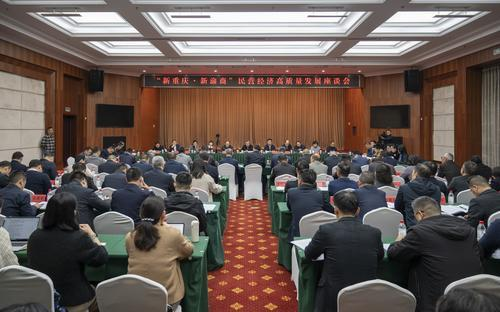
▲ The Chongqing High-quality Private Economy Development Symposium was convened on February 28. Photo by reporter He Saige
This was not an isolated initiative by a handful of companies, but rather a collective cross-sector expedition. In the opening year of the 15th Five-Year Plan, Chongqing's private enterprises are undergoing an unprecedented shift in their development paradigm: they are no longer merely focus on traditional manufacturing; instead, they have set their sights on the new quality productive forces sectors that represent future competitiveness.
This bet on the future encompasses both the transformative emergence of established industrial giants and the "phoenix-like" rise of new forces, alongside a deep, co-conceived strategy between the government and enterprises regarding application scenarios.
Sector Renewal
Traditional Giants "Reach New Heights" in Niche Sectors
For Chongqing's private enterprises of traditional manufacturing, industries of the future are not an imagination, but rather a logic of transformation found within the "hidden layers" of their existing production lines.
On Chongqing's power machinery landscape, the collaborative integration of ZONSEN and Loncin has become a bellwether for observing industrial upgrading. These two traditional giants are shifting their focus from fuel engines towards the more imaginative sector of humanoid robots.
Li Yao, Chairman of Loncin Motor, revealed that on the ZONSEN and Loncin assembly lines, humanoid robots will eventually be batch-deployed to handle complex assembly processes. The first step begins this year, with 3,500 humanoid robots arriving for an "internship". Simply, they will collect data, and once sufficiently trained, they will officially "start work".
The automotive industry has long adopted industrial arms, so why choose humanoid robots for the motorcycle industry? Li Yao explained to reporters that the motorcycle industry operates in a niche caught between high automation costs, numerous product varieties, and fast production rhythms. Traditional rigid automation lines struggle to meet such high-frequency, non-standard demands.
However, looking globally, humanoid robots haven't truly entered factories; they are still primarily used in service industries like stage performance and guidance. "Factories are too 'dirty' (complex environment), and AI needs data to feed on." In Li Yao's view, for humanoid robots to move from the lab to the real world, Chongqing's complex factory environments are the ideal training ground.
Currently, through cooperation with top-tier teams like Shanghai AGIBOT, ZONSEN and Loncin are planning to bring 3,500 robot "apprentices" into their factories in batches. These robots will transform the non-standard operational experience accumulated by veteran workers over decades into precise algorithm code.
Shifting focus to the Liangjiang New Area, Seres' super factory has already evolved into a "mechanical forest" composed of over 3,000 robotic arms. At the symposium, Zhang Xinghai, Chairman of Seres Group, revealed that they are no longer solely focused on "building a good vehicle". Their core R&D is extending towards embodied intelligence and RoboX mobile intelligent agents. This transformation means that future vehicles will no longer be just means of transportation, but intelligent agents with deep perception and self-decision-making capabilities.
Unlike Seres's large-scale transformation, Millison's evolution is reflected in breaking through the limits of micro-physics. This company, which started with precision aluminum alloy die-casting, is leveraging its globally leading ultra-large die-casting technology to tackle the heat dissipation hardware challenges of 5.5G and even 6G base stations. In a future where communication frequency bands continue to rise, this leap from traditional automotive structural components to the foundational hardware of future communications epitomizes how Chongqing's private enterprises are "reaching new heights" in their niche sectors.
Heavier Investment
Emerging Forces Seize the High Ground in the "No-Man's Land" of Technology
If the transformation of traditional giants represents the renewal of existing stock, then a batch of emerging private enterprises that have recently established themselves in Chongqing demonstrate a determination to forge ahead into the "no-man's land" of hardcore technology.
In Tongliang District, the world's first "lighthouse factory" for the energy storage industry, invested in and built by HiTHIUM, is operating at high speed. Their bet is on kilowatt-hour, long-duration energy storage cells. During this critical period of global energy transition, whoever solves the problem of long-duration electricity storage holds the key to the new power system. Industry insiders believe that HiTHIUM's investment is not just the establishment of a production line, but a crucial part of Chongqing's strategy to seize a commanding height in the global new energy storage sector.
In the low-altitude economy sector, Chongqing's private enterprises have demonstrated a strong wisdom for differentiated survival. For instance, Tuohang Technology, located in Shuangfu, Jiangjin, saw its founding team avoid the fierce competition of consumer-grade drones, choosing instead to delve deep into heavy-lift unmanned helicopters. As the only company in this field to secure continuous funding, their developed "Aerial Camel Caravan" specifically addresses the challenges of material transportation in complex mountainous environments.
Another example is IdealTech, based in Lijia Sub-district, Liangjiang New Area, a startup team with a "blend of arts and sciences backgrounds". Although founder Le Fang has an arts background, he has led the team to develop globally leading ultra-quiet drones. This technology, quieter than the sound of a fly's wings, precisely tackles the noise issue that hinders the low-altitude economy from entering urban communities.
At a more foundational level, Eagle Valley Optoelectronic is working on national substitutions for bottleneck sensors used in 6G and LiDAR. Meanwhile, Bosai Group, leveraging its control over global strategic mineral resources, has secured a cost advantage at the very source for the entire new material industry chain.
Multi-Dimensional Resonance
A Tripartite Synergy of Industry Demands, Corporate Resilience, and Government Guidance
Why are Chongqing's private enterprises increasingly placing their bets on industries of the future?
Analysts believe this is the result of a tripartite synergy: industry demands, corporate resilience, and strong government guidance.
Looking back, Chongqing's private enterprises have weathered the pains of "digital and intelligent" transformation and accumulated a crucial digital foundation. Against the backdrop of global industrial chain restructuring, profit margins in traditional low-end manufacturing have frozen to near zero. Entrepreneurs in Chongqing are keenly aware that without mastering core technologies with characteristic of new quality productive forces, they will have no say in the next decade. This transformation is both an instinct for survival and an inevitable step in evolution.
At the same time, Chongqing's complex geographical environment and diverse industrial sectors themselves serve as the ultimate "whetstone" for sharpening industries of the future. As conveyed during the symposium, compared with simple financial subsidies, entrepreneurs place greater value on the open application scenarios provided by the government. The orderly opening of low-altitude airspace, pilot projects in smart factories, and the desensitized sharing of industrial data...the provision of these scenarios allows laboratory technologies to quickly take root and flourish in the fertile ground of Chongqing.
Furthermore, government guidance is demonstrating precise driving force at this juncture. Examples include the "Zhirong Huichang" project, which enhances financing efficiency through digital means, channeling financial resources precisely to tech-focused private enterprises. Another is the "Qianlima Action" plan, which matches high-growth companies with dedicated resource support to help them scale rapidly. Additionally, institutional innovations like fair competition reviews and a "QR code for entering enterprises" not only dismantle invisible barriers preventing private enterprises from entering cutting-edge fields, but also protect entrepreneurial R&D enthusiasm through a legal environment that ensures "non-interference when unnecessary".
Clearly, Chongqing's private enterprises betting on industries of the future is not speculation on a passing trend, but a rational expedition grounded in reality. They are pouring "new wine", new quality productive forces, into the "old bottles" of traditional manufacturing, seeking a path to the higher echelons of the global industrial chain within the hidden layers of this mountain city.
As an entrepreneur succinctly put it at the conclusion of the symposium, Chongqing's private economy is shifting from being "scale-driven" to "technology-driven". When humanoid robots deftly tighten the first screw on a production line, and heavy-lift drones cut through the city's mountain mist, Chongqing's private enterprises have already begun their quiet yet decisive battle for the future.
Source: Chongqing Daily

 渝公网安备 50010502003501号