

Investment in high-tech manufacturing Increasing by 17.1%, and multiple economic indicators of the Chengdu-Chongqing Economic Circle Taking the lead in western China in the first half of 2026
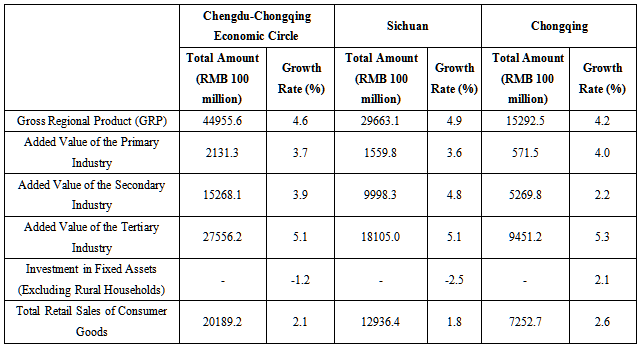
On September 23, the statistical bureaus of Sichuan and Chongqing jointly announced that in the first half of 2026, the added value of the primary industry in the Chengdu-Chongqing Economic Circle increased by 3.7% on a year-on-year basis; the added value of the secondary industry increased by 3.9%, with a growth rate higher than that of the western region by 0.2%; the added value of the tertiary industry increased by 5.1%, with a growth rate higher than that of the western region by 0.8%, firmly maintaining its position as the “leader” of economic development in western China.
The sustained boost of industrial momentum and the accelerated, efficiency-enhanced and high-quality development of the manufacturing sector are the most prominent highlights in economic development in the Chengdu-Chongqing Economic Circle in the first half of 2026. During this period, both the industrial added value and the manufacturing added value of the Chengdu-Chongqing Economic Circle increase by 5.6%, achieving a key leap from trailing the national average to surpassing it, with the two indicators 0.2% and 0.1% higher than the national level respectively, marking a remarkable enhancement in resilience and endogenous driving force of the industrial economy.
Main Indicator Data of Chengdu-Chongqing Economic Circle in First Half of 2026
▲Source: Municipal Statistical Bureau
A number of landmark industrial projects have been implemented and delivered tangible results, becoming the “hard core support” for industrial quality improvement of Sichuan and Chongqing. For example, in the field of high-end equipment manufacturing, the UAV comprehensive project in Liangping District, Chongqing has completed its general assembly and rolled off the production line, filling the gap in the regional sector of high-end intelligent aviation equipment. In the sector supporting new energy vehicles, the sodium-ion battery production base project in Neijiang City, Sichuan is accelerating its construction, and the cluster of new-type energy storage industries is taking shape rapidly. In the field of digital intelligent manufacturing, Chongqing Geega’s AI industrial platform deeply empowers the automotive industry chain in Chengdu and Chongqing, while the digital technology continuously drives the transformation and upgrading of traditional manufacturing sectors in Chengdu and Chongqing.
In terms of investment, the industrial investment in Chengdu-Chongqing Economic Circle increases by 7% on a year-on-year basis in the first half of 2026, with a growth rate higher than the national average by 8.1%. Among others, the investment in manufacturing sectors increases by 9.4%, and that in high-tech manufacturing sector increases by 17.1%, with a grow rate higher than that in the first quarter by 1%, and higher than the national average by 13.9%, showing an increasingly prominent trend of innovation-driven investment. In terms of major project construction, the key projects jointly built in Chengdu and Chongqing completed an investment of RMB 286.239 billion in the first half of 2026. The investments in modern industry and technological innovation projects exceed RMB 120 billion. A number of scientific and technological innovation carriers and industrial platforms are taking shape at an accelerated pace, building up momentum for industrial upgrading.
In terms of consumption, the consumer market of Chengdu-Chongqing Economic Circle continued to recover in the first half of 2026. The total retail sales of consumer goods in Chengdu and Chongqing increase by 2.1%, with a growth rate higher than national average by 0.8%. Among others, the added value of the accommodation and catering industry increases by 6.9%. Meanwhile, new forms of consumption in both regions continue to expand. The retail sales of Internet goods by enterprises above designated size increase by 7.8%, driven by the deep integration of online and offline channels and the continuous innovation in new consumption forms.
The accelerated upgrading of modern service sectors and the continuous improvement of industrial service capacity is another highlight in construction of the Chengdu-Chongqing Economic Circle in the first half of 2026. During this period, the added value of the leasing and business service sector in Chengdu and Chongqing increases by 15.8%, with a growth rate higher than the national average by 3.9%; the added value of the information transmission, software and information technology service sector increases by 8.6%. The high-end service sectors including digital services, business services and technology services continue to expand, supporting the high-quality development of advanced manufacturing and modern agriculture, and forming a two-way empowerment pattern of “manufacturing + services”.
Leveraging the collaborative advantages of open platforms in the Chengdu-Chongqing Economic Circle, the total foreign trade import and export volume of Chengdu and Chongqing has expanded at an accelerated pace. In the first half of 2026, the regional total import and export volume of Chengdu and Chongqing increases by 14.4%, with exports rising by 10.7% and imports by 21.1%. In particular, the competitive products such as automobiles and motorcycles, equipment, and pharmaceuticals and medical devices are continuously expanding into overseas markets, while the pattern of Sichuan and Chongqing joining forces to go global and pursuing coordinated opening-up is accelerating.
In addition, the people’s livelihoods in Chongqing and Chengdu have been continuously improved, and the benefits of development are shared by all the people. In the first half of 2026, the average surveyed urban unemployment rate in both Chongqing and Sichuan stands at 5.3%, remaining unchanged from the same period last year. In the Chengdu-Chongqing Economic Circle, 913,000 new urban jobs are created, representing a year-on-year increase of 6.9%, with the growth rate higher than that in the first quarter by 0.2%. The urban-rural disparity continues to narrow. The ratio of per capita disposable income between urban and rural residents in Chongqing and Sichuan has dropped to 2.32 and 2.07 respectively, decreasing by 0.05 and 0.04 compared with the same period of the previous year, highlighting the remarkable achievements in the integrated urban-rural development.
In the first half of 2026, Chongqing and Sichuan continue to deepen the cross-regional joint prevention, joint treatment and collaborative governance of ecological environment. Among others, the average PM2.5 concentration in prefecture-level and above cities in Chongqing reaches 30.6 micrograms/m3, and that in Sichuan reaches 29.6 micrograms/m3, decreasing by 16.4% and 12.4% on a year-on-year basis respectively. The ecological advantages of “blue sky, green land and clear water” in Chengdu and Chongqing have been continuously consolidated, building a solid ecological barrier for green, low-carbon and high-quality development.
Source: Chongqing Daily
 渝公网安备 50010502003501号